Ground Truths - Alternative Project Delivery
Alternative Project Delivery (APD) Is Changing When Geotechnical Decisions Get Made
CMAR, CM/GC, design-build, and progressive design-build can improve collaboration, but only if subsurface risk is addressed before budgets and schedules become fixed.
For decades, many construction projects followed a familiar sequence: the owner hired a design team, the design team completed the plans, contractors bid the completed documents, and construction began.
That traditional design-bid-build (DBB) model remains the default public construction delivery method in Virginia and the US. However, owners are increasingly using alternative approaches that bring contractors and specialty consultants into the process earlier. These include core delivery methods such as Construction Manager at Risk (CMAR), Construction Manager/General Contractor (CM/GC), design-build (DB), progressive design-build (PDB), and integrated project delivery (IPD), as well as related financing, programmatic, and contracting structures such as public-private partnerships (PPP or P3) and task-order arrangements. Engineering, Procurement, and Construction (EPC), used most often for energy, industrial, manufacturing, and other private infrastructure projects, most closely resembles design-build because a single entity assumes integrated responsibility for design and construction, while also managing equipment and material procurement.
The shift is measurable. A review of Virginia Department of General Services procurement-evaluation records indicates growth in proposed construction-management projects in recent fiscal years, with the recent pipeline particularly concentrated in university, healthcare, laboratory, utility, residence-hall, and other complex institutional projects. Virginia’s current statutory framework expressly authorizes construction management and design-build for qualifying public projects, while North Carolina’s Department of Transportation now maintains a dedicated program covering design-build, CM/GC, progressive design-build, and express design-build.
Federal procurement is moving in the same direction. The Federal Acquisition Regulation (FAR) expressly provides for two-phase design-build procurement, and the U.S. General Services Administration uses Construction Manager as Constructor (CMc) – a federal analogue to CMAR/CM/GC – for major capital projects. More recently, the National Defense Authorization Act for Fiscal Year 2026 expressly authorized both accelerated design-build and progressive design-build for military construction projects, expanding the federal toolkit for bringing designers and constructors together earlier in project development. The U.S. Army Corps of Engineers is also evaluating progressive design-build, design-build-to-budget, integrated design and construction, and early contractor involvement as tools to improve schedule, cost control, constructability, and risk management.
These delivery methods can improve collaboration, constructability, schedule control, and cost visibility. But they also change when geotechnical decisions must be made, and who relies on those decisions.
Alternative project delivery does not eliminate subsurface risk. It moves many of the decisions, assumptions, and financial consequences earlier.
Why the Delivery Method Matters Below Ground
In a traditional design-bid-build project, the geotechnical investigation is generally performed for the owner and design team. The resulting report supports final foundation, earthwork, pavement, retaining-wall, and site-development design. The contractor typically receives that information much later, after many important design decisions have already been made.
Under alternative delivery, the contractor may participate during schematic design, or even before significant design work begins. In CMAR and CM/GC, the construction manager provides preconstruction input before negotiating the eventual construction price. Under design-build, one entity generally assumes responsibility for both design and construction. Progressive design-build goes further by selecting the design-builder primarily on qualifications and collaboration, then developing the design, scope, risk allocation, and construction price progressively with the owner.
FHWA describes CM/GC as a two-phase process in which the contractor assists during design and later has the opportunity to negotiate the construction contract. In design-build, the owner establishes the project requirements while the design-builder determines how to complete the design and construct the work.
Gransberg and Molenaar (2019) provide a useful side-by-side comparison of design-bid-build, conventional design-build, progressive design-build, and CM/GC project sequencing. Their analysis concludes that progressive design-build and CM/GC are nearly identical in their overall project-development format. The principal distinction is responsibility for design: the owner retains the designer and design responsibility under CM/GC, while those responsibilities are assigned to the design-builder under progressive design-build.
The authors’ project-delivery sequence also illustrates an important practical difference among the methods. Under design-bid-build, the constructor generally enters after design is substantially complete. Conventional design-build introduces the design-builder earlier, while progressive design-build and CM/GC allow meaningful constructor participation during preliminary engineering and design development. This earlier involvement creates a better opportunity to investigate subsurface uncertainties before foundation concepts, construction sequencing, contingencies, and pricing assumptions become difficult to change. This earlier contractor involvement creates opportunities to make better geotechnical decisions. It also creates potential gaps.
The original investigation may have been adequate for preliminary design but may not answer construction-specific questions involving:
Undercut quantities and unsuitable-soil allowances
Temporary access, haul routes, and crane working areas
Excavation support and temporary slopes
Groundwater control and dewatering
Foundation installation sequencing
Early utility or earthwork packages
Material reuse and moisture conditioning
Work adjacent to occupied buildings or sensitive utilities
Ground improvement design
Construction phasing across an active campus or facility
A geotechnical report prepared for final design should not automatically be assumed to address every contractor means-and-methods question, construction logistics issue, or pricing contingency. As illustrated in Figure 1, alternative delivery methods generally bring constructors and key specialty consultants into the project earlier, creating a broader window to identify and reduce geotechnical risk before design, pricing, and scheduling decisions become fixed.
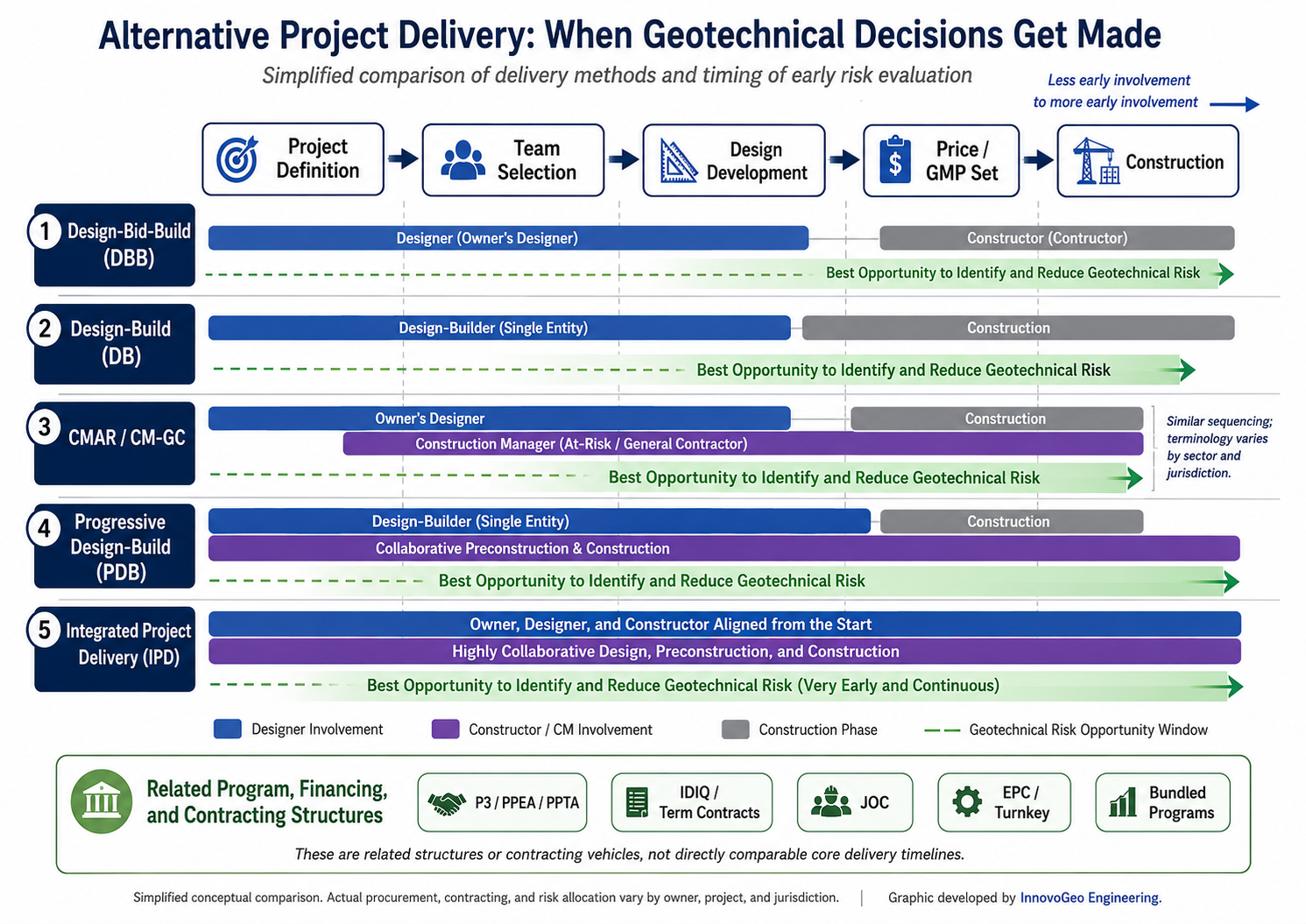
Figure 1. Alternative Project Delivery Timeline Comparison
The “One Investigation, Two Purposes” Problem
Alternative-delivery teams often try to use one geotechnical investigation for two related but different purposes. The first purpose is engineering design: determining suitable foundation systems, evaluating settlement, developing earthwork recommendations, and supplying design parameters. The second is construction-risk evaluation: determining what the contractor should carry in its price and schedule for variable soils, groundwater, temporary access, excavation, stabilization, and potential differing conditions. A well-planned investigation can support both purposes, but only when the project team identifies those needs early.
For example, several conventional SPT borings may adequately characterize foundation conditions beneath a planned building. Those same borings may provide limited information about a long crane route, staging area, utility corridor, temporary haul road, or broad area of variable undocumented fill. Conversely, a rapid supplemental investigation intended to delineate weak zones may be extremely useful for pricing and logistics while not replacing the investigation needed for final foundation design.
The solution is not always “more borings.” It is to identify the decisions the team must make and collect the type, location, and density of information needed for those decisions.
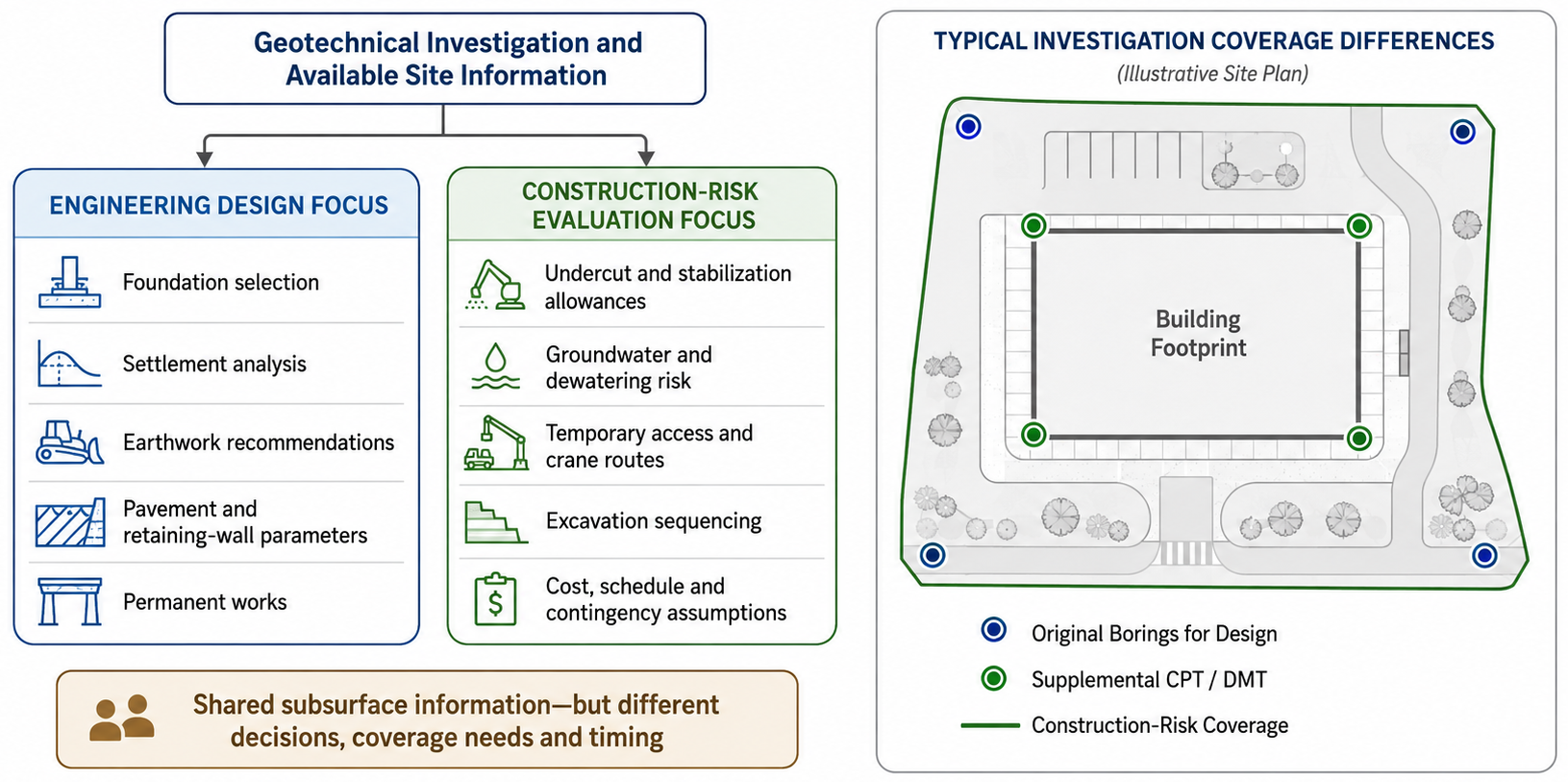
Figure 2. One geotechnical investigation may be expected to support both permanent design and construction-risk evaluation, but the two purposes frequently require different investigation locations, methods, timing and levels of coverage.
What Geotechnical Uncertainty Costs
Published transportation data show why subsurface risk deserves explicit treatment in project budgets. Boeckmann and Loehr (2016) found that subsurface conditions represented about 5 percent of claims, change orders, and cost overruns by number, but 7 percent by cost. Responding agencies commonly reported annual subsurface-condition change orders in the millions of dollars, with values as high as $10 million per agency; those change orders approached 1 percent of total agency budgets for new construction. At the project level, one agency reported that its average subsurface-condition change order alone consumed about 7 percent of the associated project budget. These are agency-level transportation data rather than universal benchmarks, but they demonstrate that ground-related uncertainty can consume a meaningful share of contingency and project funding. For a broader discussion of the relationship between subsurface uncertainty, site investigation effort, and project cost, see InnovoGeo’s related Ground Truths article, Geotechnical Risks and Costs.
The cost relationship becomes even more striking when investigation spending is compared with downstream consequences. In a historical study of 58 UK transportation projects summarized by Boeckmann and Loehr (2016), three-quarters of the projects had cost overruns greater than 10 percent of contract value, and about half of the overruns were attributed to geotechnical causes. Direct geotechnical overruns averaged about 3 percent of contract cost, compared with average site-investigation spending of about 1 percent; indirect delay and disruption costs averaged another 5 percent. The point is not that every project should spend a fixed percentage on investigation, but that relatively small investigation budgets can be weighed against much larger avoidable cost and schedule exposure.
Design-build changes where that uncertainty is priced. McLain et al. (2014) explain that public-sector design-builders often commit to a firm fixed price before geotechnical design and investigation are complete. When information is inadequate, bidders may add a worst-case contingency or decline to bid. Gransberg et al. (2018a) found that geotechnical investigations on 11 design-build projects in nine state DOTs cost approximately 0.25 to 0.5 percent of total project budget, while investigation duration ranged from six months to 1.5 years. In the companion case-study report, Gransberg et al. (2018b) document a WSDOT design-build contract assigning the first $10 million of differing-site-condition exposure to the design-builder, Dulles Corridor Metrorail design-build thresholds of roughly $2 million to $3 million, and a separate $672,000 geotechnical-related change order involving buried debris and boulders. These are project-specific amounts, but they show how incomplete subsurface definition can become contingency, retained owner exposure, or a realized change.
CMAR and CM/GC can shift the economic decision again because the contractor is present while the owner still controls the design and can authorize targeted investigation before the GMP or construction price is fixed. In the agency survey appendix to Boeckmann and Loehr (2016), Nevada DOT reported approximately $2 million in savings on the Moana I-580 Interchange, a CMAR project where the delivery structure allowed the agency and contractor to discuss risk and perform additional investigation. The same logic underlies progressive design-build: Gransberg et al. (2018a) recommend using the progressive phase to investigate and jointly price geotechnical risk after more information is available rather than forcing bidders to bury uncertain conditions in an early lump-sum contingency. The supplied literature, however, does not provide enough comparable project-level data to assign a reliable geotechnical cost premium or savings percentage to CMAR, PDB, or IPD.
For subsurface-intensive underground work, the potential contingencies can be even larger. The American Society of Civil Engineers (ASCE) Manual of Practice 154 (2022) recommends quantitative risk assessment to support owner contingency and notes that, depending on project complexity, a contingency fund may range from about 5 to 25 percent of anticipated bid cost. That range is specific to underground construction and should not be generalized to ordinary buildings or site-development work. It illustrates that when subsurface conditions control production, equipment, and the critical path, the reserve for uncertainty can become a major budget component. Across the sources reviewed here, quantitative evidence is strongest for DBB and design-build transportation or underground projects; evidence for CMAR, progressive design-build, and especially IPD remains more limited. The comparison therefore should focus on how each method exposes, prices, shares, or mitigates risk rather than implying a universal percentage.
VDOT Scope Validation: A Defined Window for Resolving Risk
The Virginia Department of Transportation’s design-build contracts provide a particularly clear example of how alternative delivery can move geotechnical risk evaluation to the beginning of a project. VDOT (2016) standard design-build general conditions establish a Scope Validation Period beginning when the design-builder receives notice to proceed. The standard conditions use 120 days unless the project-specific contract establishes another duration. During that period, the design-builder must review the contract documents and its proposal, validate the proposed design concept, and identify defects, errors, or inconsistencies that materially affect its ability to complete the work within the contract price or time.
Loulakis et al. (2015), in NCHRP Legal Research Digest 68, describe VDOT’s scope-validation process as a deliberate effort to balance effective risk transfer and price certainty against the practical limitations of broad disclaimers for owner-furnished information. Scope validation is a defined contractual opportunity providing the design-builder a defined post-award period to identify deficiencies in the RFP information before responsibility for unreported issues shifts more fully to the design-builder. The digest notes that VDOT had encountered scope-validation claims involving inaccurate survey information and subsurface conditions differing from the RFP documents.
VDOT (2016) requires a design-builder seeking relief to provide a written General Notice before the period expires and generally to follow with supporting documentation within 21 days. That documentation must connect the condition to the assumptions used in the proposal, explain why the issue could not reasonably have been identified earlier, and demonstrate its material effect on price or time. After the period expires, the standard conditions generally place responsibility for unnotified scope issues on the design-builder.
On a scope-validation project, early geotechnical investigation is not only a design activity, it is part of the project’s contractual risk-management process.
Why the period is especially important below ground
Subsurface conditions cannot be validated solely by comparing drawings and written requirements. Meaningful validation may require field investigation, laboratory testing, engineering interpretation, and comparison with the assumptions carried in the design-builder’s proposal. VDOT (2016) standard conditions specifically address additional geotechnical evaluations. When the design-builder intends to supplement or corroborate the geotechnical information included in the RFP documents, those evaluations are to be performed during the Scope Validation Period. The conditions also provide a limited mechanism for areas that are not accessible during the original period: when VDOT agrees that an area is inaccessible, the validation period for geotechnical issues in that area may extend for 30 days after access becomes available.
This creates a demanding early-project sequence that typically includes: identifying the geotechnical assumptions in the proposal; prioritizing those with the greatest potential cost or schedule consequence; obtaining site access and clearances; completing targeted field and laboratory work; interpreting results against the RFP information; quantifying material effects on design, quantities, methods, price, or schedule; and submitting any required contractual notice before the applicable deadline. Deferring the investigation until final design may produce adequate design information but still miss the contractual window for identifying a scope issue.
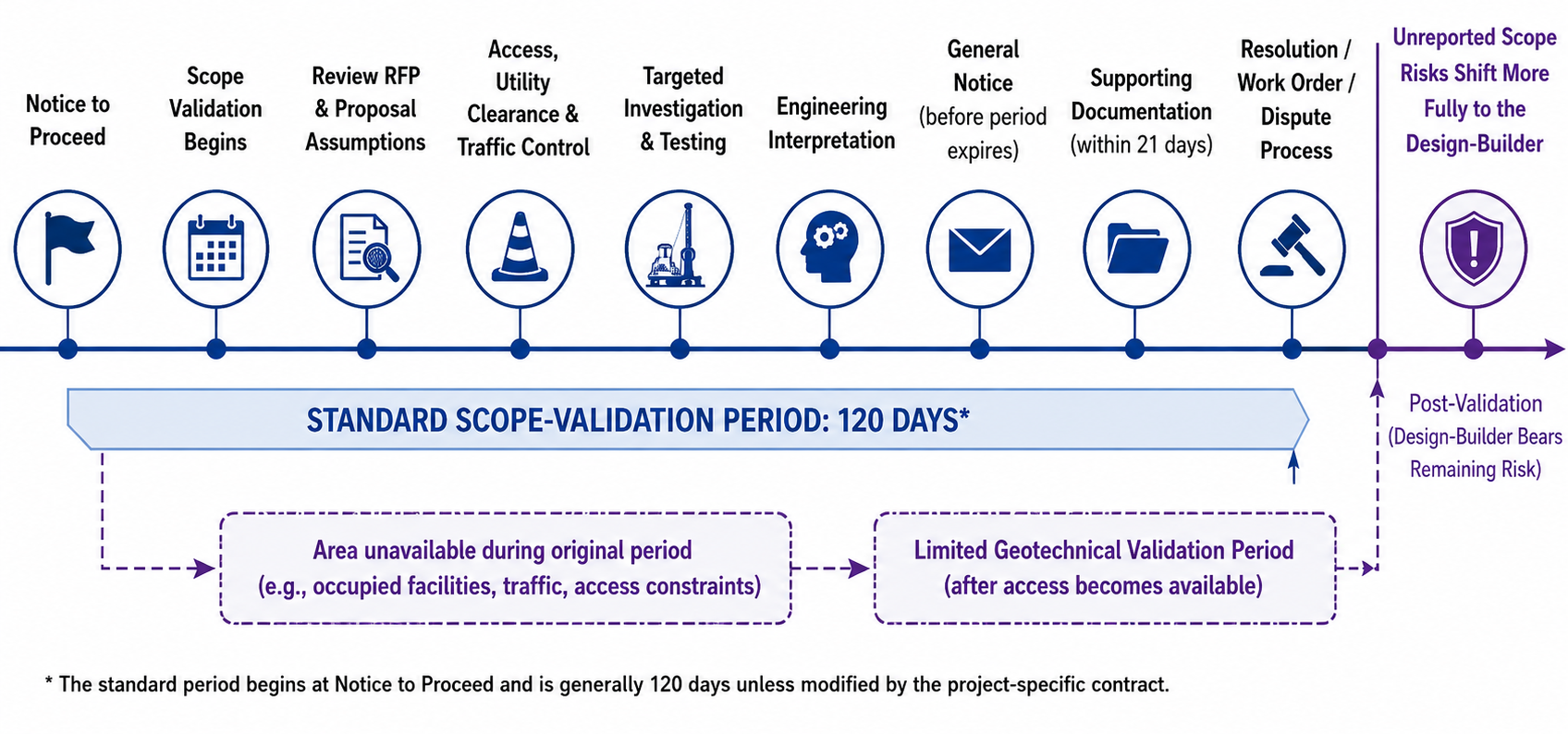
Figure 3. Simplified VDOT scope-validation process. Investigation, interpretation and notice must be completed early enough to preserve the design-builder’s ability to identify qualifying scope issues. Actual requirements and deadlines are controlled by the project-specific contract.
Differing site conditions and the shift in risk
The consequences can extend beyond inconsistencies in the written scope. VDOT (2016) standard general conditions state that the design-builder generally is not entitled to an adjustment for differing site conditions that were not identified during the Scope Validation Period unless VDOT determines, in its discretion, that an adjustment is justified. VDOT (2024) construction change-management guidance also states that entitlement for a Type I differing site condition cannot be established after the scope-validation period has expired.
A Type I condition generally involves physical or subsurface conditions that materially differ from those indicated in the contract documents. Where the contract indicates subsurface conditions, the design-builder may have only a limited post-award period to test those indications and preserve a potential basis for relief. (For Federal projects, FAR 52.236-2 describes differences between Type 1 and 2 Differing Site Conditions.)
The exact rights and obligations depend on the project-specific RFP and executed contract. Nevertheless, the general risk-management lesson applies broadly:
The value of geotechnical information depends not only on its technical quality, but also on whether it is obtained, evaluated, and communicated in time to affect contractual risk allocation.
A risk-based validation strategy
A scope-validation investigation should not automatically repeat the owner’s preliminary exploration or attempt to investigate every part of the project at equal intensity. It should prioritize the conditions most capable of materially affecting the design-builder’s price, schedule, or technical approach, such as rock elevation and rippability, soft or compressible soils, variable fill, groundwater and dewatering, geologic hazards, foundation installation conditions, retaining systems, pavement subgrades, and access limitations that prevent timely investigation of critical areas.
Rapid methods such as cone penetration testing, dynamic probing, geophysics, and targeted shallow exploration can help increase coverage within a compressed period. Conventional borings, rock coring, groundwater monitoring, and laboratory testing remain necessary where samples, rock characterization, or longer-term observations are required. The investigation program should be selected around the risks being validated rather than around a predetermined testing method.
Equally important, as illustrated in Figure 4, the geotechnical team should maintain a clear record linking:
RFP information → proposal assumption → validation data → engineering interpretation → price or schedule consequence
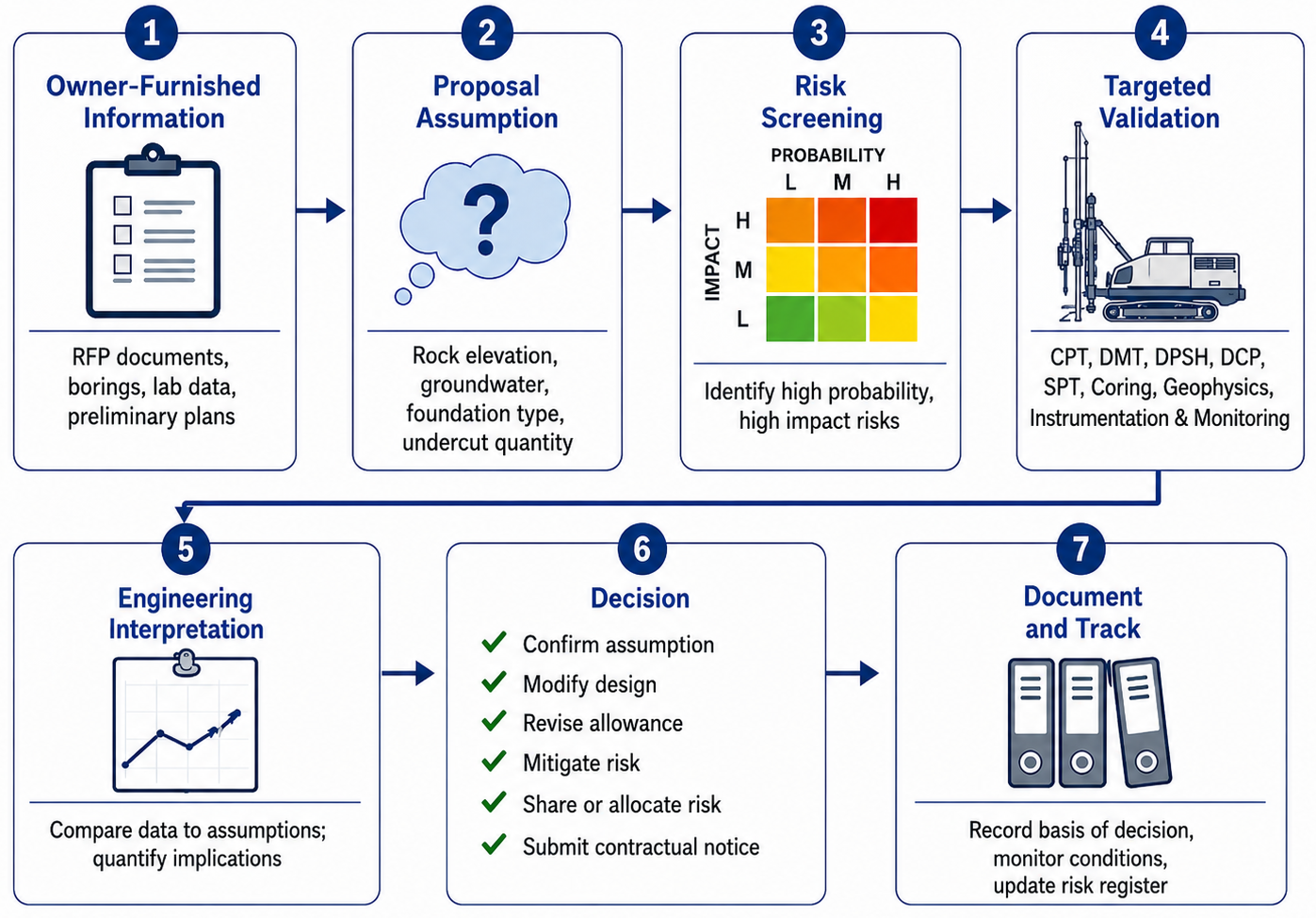
Figure 4. Geotechnical validation should create a documented connection between the information furnished during procurement, the assumptions incorporated into the proposal, the results of supplemental investigation and the resulting project decision.
For instance, if the RFP indicates shallow rock and the proposal assumes standard excavation, but validation data reveals unrippable bedrock, the documented engineering interpretation can directly support the necessary schedule and price adjustments. That documentation can be as important as the field data itself when the team must determine whether a finding represents ordinary design development, a manageable variation, a differing site condition, or a qualifying scope issue.
VDOT’s Scope Validation Period therefore illustrates the larger principle behind alternative project delivery: bringing the project team together earlier creates an opportunity to reduce uncertainty, but the opportunity is time-limited. Real value comes from organizing the investigation, analysis, and decision-making process early enough to use it.
Earlier Involvement Requires Clearer Roles
Alternative delivery brings more parties together earlier as shown in Figure 5, but collaboration does not eliminate the need for clear contractual boundaries.
Figure 5. Typical contractual and coordination relationships under CMAR/CM-GC and design-build delivery. Actual relationships vary, and the geotechnical engineer’s scope, reliance parties and responsibility should be expressly defined.
The project should identify:
Who is the geotechnical engineer of record?
Who may rely on the geotechnical report?
Is the consultant working for the owner, designer, construction manager, or design-builder?
Does the scope include permanent design, construction-risk advice, temporary works, or some combination?
Who is responsible for independent quality-assurance testing?
Who controls construction means, methods, sequencing, and safety?
How will supplemental investigation findings be incorporated into the contract documents and pricing?
What happens when actual conditions differ from the information available during preconstruction?
These questions are particularly important when one geotechnical firm supports the permanent design while another advises the contractor, or when the original report is being used by parties that were not involved in establishing its scope. Clear roles allow the geotechnical consultant to contribute meaningfully without creating confusion over responsibility.
Five Ways InnovoGeo Geotechnical Support Can Improve Alternative-Delivery Projects
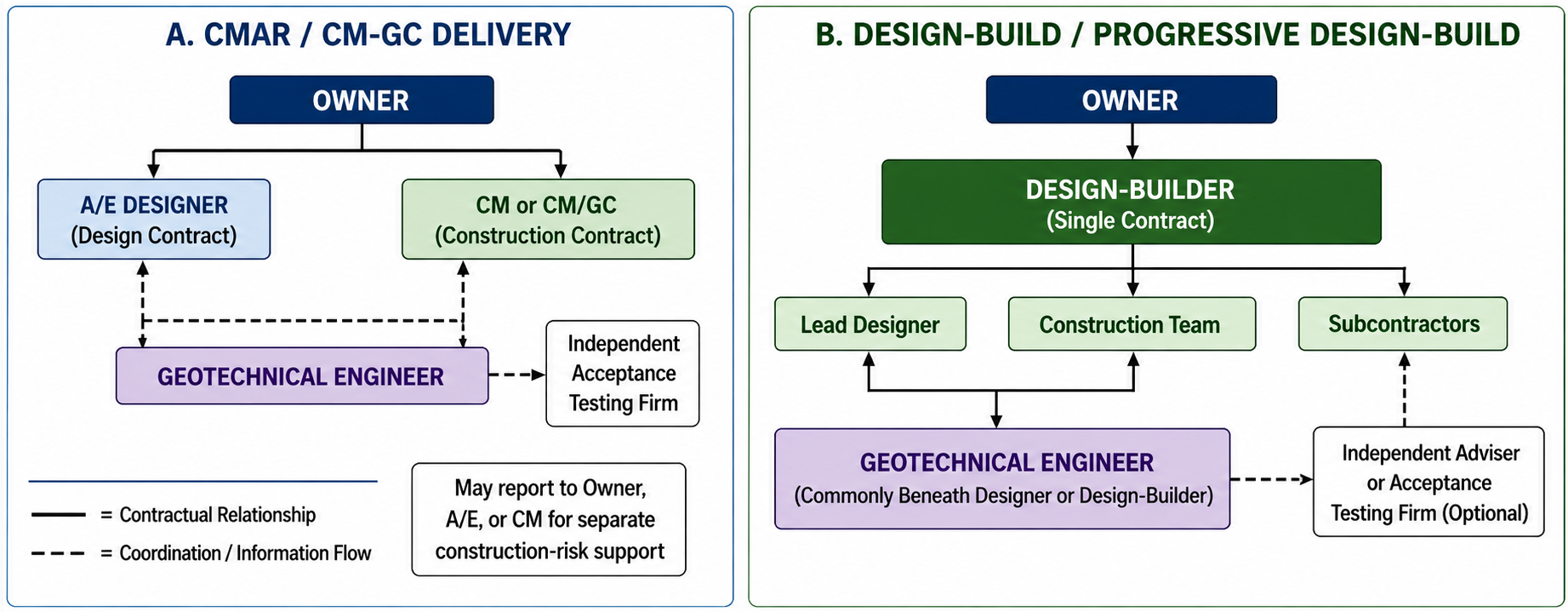
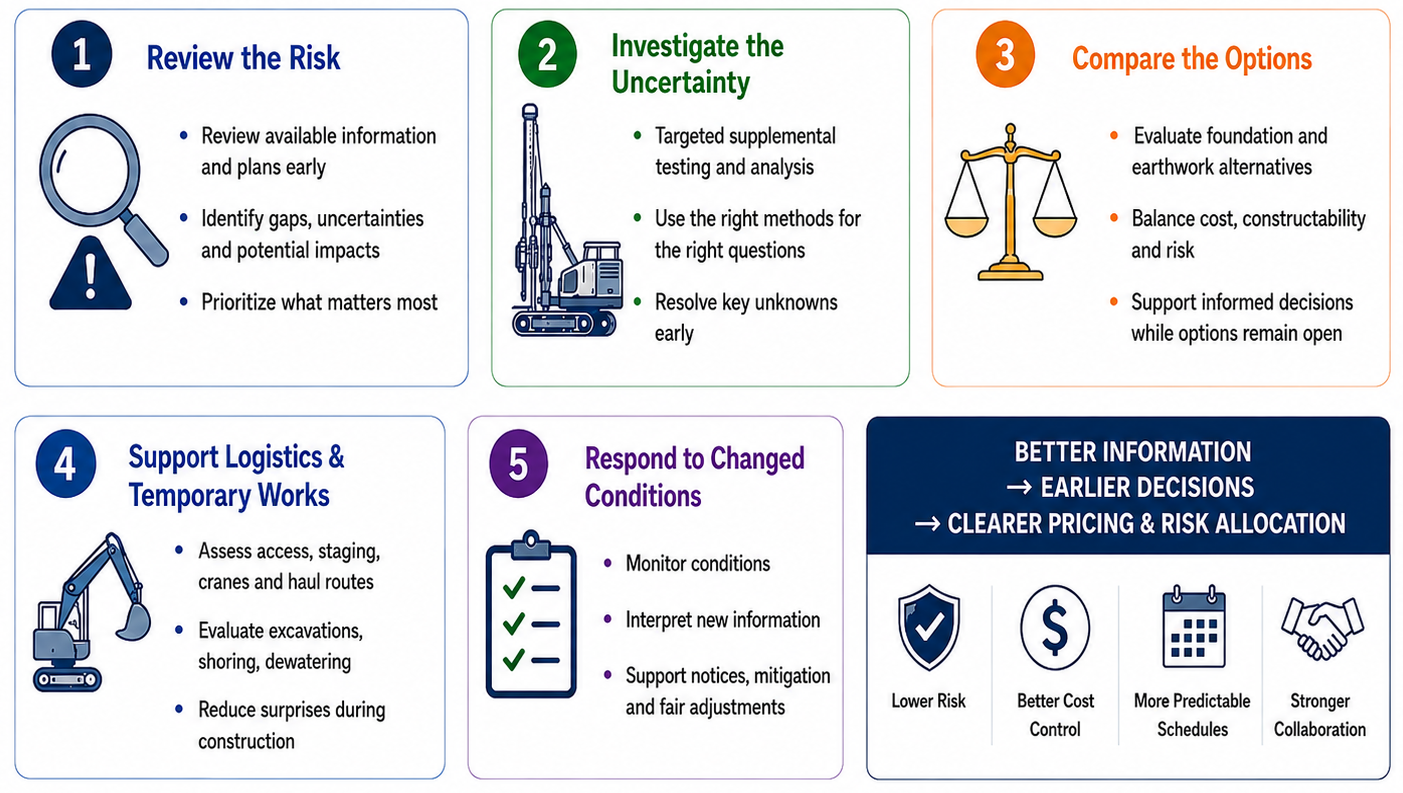
Figure 6. Five Ways Geotechnical Support Adds Value.
Proactive geotechnical support at the right time helps project teams make better decisions, protect budgets, and keep projects moving forward.
1. Early geotechnical risk review
Before the construction price or guaranteed maximum price is established, the team should review the available subsurface information against the current plans, construction approach, and risk register. That review may identify:
Areas not adequately covered by the original investigation
Potential overconservative design parameters based on conventional SPT borings
Foundation or earthwork assumptions that need confirmation
Groundwater information that is seasonal or incomplete
Potential conflicts between design recommendations and planned sequencing
Risks that should be investigated rather than carried as a broad contingency
Risks that cannot be eliminated and should be clearly allocated contractually
A focused review can help distinguish between a manageable assumption and a potentially costly unknown.
2. Targeted supplemental investigation
Alternative-delivery projects rarely benefit from waiting until final design to resolve every uncertainty. Supplemental testing can instead be directed toward specific questions, such as:
How far does an area of soft or variable fill extend?
Is a planned working area likely to require stabilization?
Do foundation conditions vary between widely spaced borings?
Is groundwater likely to affect an early excavation package?
Can a shallow foundation option be preserved in a particular portion of the site?
What conditions exist beneath a limited-access area that cannot accommodate a conventional drill rig?
Would installing instrumentation and monitoring systems be beneficial?
Methods such as cone penetration testing (CPT), dilatometer testing (DMT), dynamic probing (DPSH), shallow sampling, test pits, and conventional drilling can be combined according to the project objective. The best method is the one that produces the information needed for the pending decision – not simply the method most familiar to the team.
Boeckmann and Loehr (2016) also report a Louisiana DOT survey response estimating CPT exploration at roughly 40 percent less cost than conventional borings of equal depth for certain interstate median-barrier projects, with additional field-time savings. That project-specific estimate is not a universal CPT discount, but it illustrates how targeted methods can increase coverage without simply multiplying conventional borings.
3. Foundation and earthwork option evaluation
Alternative delivery creates an opportunity to evaluate constructability and cost while design options are still open. The geotechnical engineer can help compare:
Shallow foundations versus deep foundations
Removal and replacement versus in-place improvement
Lime, cement, aggregate, or geosynthetic stabilization
Conventional slabs versus ground-supported structural systems
Alternate retaining systems
Imported select fill versus conditioning and reuse of onsite soils
Different grading and foundation sequencing strategies
These comparisons should be coordinated with the structural engineer, civil engineer, contractor, and owner. A technically feasible option is not necessarily the best project solution when schedule, equipment access, material availability, and risk are considered together.
4. Construction logistics and temporary works support
Permanent foundation design is only one part of ground-related project risk. Large equipment may need to cross existing utilities. Cranes may require working platforms. Delivery routes may traverse newly placed fill. Temporary stockpiles may affect nearby slopes or buried structures. Excavations may need to remain open while other work proceeds. These issues are especially important on active campuses, healthcare sites, data centers, industrial facilities, and constrained urban properties.
The contractor remains responsible for construction means, methods, sequencing, and safety. However, project-specific geotechnical evaluation can provide the soil parameters, field information, and engineering analysis needed to support informed temporary-work and logistics decisions.
5. Rapid response when conditions change
No investigation can expose every cubic yard of soil before construction. The benefit of early collaboration is therefore not only better initial information. It is also establishing a process for responding when actual conditions differ from expectations. That process may include:
Rapid site observation by a geotechnical engineer
Targeted testing to define the extent of an unexpected condition
Evaluation of stabilization or foundation alternatives
Documentation of observed conditions
Evaluation of instrumentation and monitoring data throughout construction
Coordination among the owner, designer, contractor, and testing agency
Clear identification of decisions requiring formal design revisions
The goal is not to eliminate every surprise. It is to prevent a localized condition from becoming an extended delay while the project team determines who should evaluate it and what information is needed.
A Better Time to Ask Ground-Related Questions
Alternative project delivery offers a significant advantage: the project team can address subsurface risk while there is still time to change the design, sequence the work differently, obtain additional information, or allocate the remaining risk deliberately. That advantage is lost when the geotechnical report is treated as a completed administrative “checkbox” requirement rather than a working source of project information.
The most valuable questions are often not:
“Do we have a geotechnical report?”
“How many borings were completed?”
“Was the report included in the procurement package?”
The better questions are:
“What decisions must this information support?”
“What uncertainties remain?”
“Which assumptions are included in the price and schedule?”
“What can still be investigated before those assumptions become commitments?”
“Who will respond when actual conditions differ?”
As CMAR, CM/GC, design-build, progressive design-build, and other collaborative models become more common, geotechnical services must evolve with them. The investigation remains important. But the greater value comes from turning subsurface information into timely decisions about design, constructability, cost, logistics, and risk.
These principles are grounded in practical project experience. InnovoGeo and its founder have supported owners, design teams, contractors, and design-build teams on alternative-delivery projects ranging from transportation and federal infrastructure to energy, data centers, and site development. That experience has included early geotechnical risk reviews, bid- and preconstruction-phase investigations, development of project risk registers, evaluation of foundation and earthwork alternatives, construction-logistics and temporary-works assessments, and rapid supplemental testing when additional information was needed to keep design and construction decisions moving forward. Across these roles, the objective has been consistent: identify the geotechnical uncertainties that matter most, obtain the right information at the right time, and help the project team make better-informed decisions before those uncertainties become avoidable cost, delay, or contractual disputes.
How InnovoGeo Supports Alternative Project Delivery
InnovoGeo Engineering provides principal-led geotechnical support for owners, design consultants, construction managers, design-builders, and specialty contractors, including:
Review of existing geotechnical information and construction assumptions
Targeted supplemental investigations
Advanced in-situ testing (such as CPTu, and DMT), shallow sampling, geophysical, and limited-access testing
Foundation, settlement, earthwork, and stabilization evaluations
Crane-route, working-platform, haul-road, and temporary-access evaluations
Support for early work packages and preconstruction risk registers
Rapid investigation and engineering response to unexpected conditions
References
Boeckmann, A. Z., and Loehr, J. E. (2016). Influence of Geotechnical Investigation and Subsurface Conditions on Claims, Change Orders, and Overruns. NCHRP Synthesis 484. Transportation Research Board, Washington, D.C.
Gransberg, D. D., Loulakis, M., Touran, A., Gad, G., McLain, K., Sweitzer, S., Pittenger, D., Castro Nova, I., Tapia Pereira, R., and Pinto-Nunez, M. (2018a). Guidelines for Managing Geotechnical Risks in Design-Build Projects. NCHRP Research Report 884. Transportation Research Board, Washington, D.C.
Gransberg, D. D., Loulakis, M., Touran, A., Gad, G., McLain, K., Sweitzer, S., Pittenger, D., Castro Nova, I., Tapia Pereira, R., and Pinto-Nunez, M. (2018b). Managing Geotechnical Risks in Design-Build Projects. NCHRP Web-Only Document 247. Transportation Research Board, Washington, D.C.
Gransberg, D. D., and Molenaar, K. R. (2019). Critical Comparison of Progressive Design-Build and Construction Manager/General Contractor Project Delivery Methods. Transportation Research Record: Journal of the Transportation Research Board, 2673(1), 261-268. doi:10.1177/0361198118822315.
Loulakis, M. C., Smith, N. C., Brady, D. L., Rayl, R. E., and Gransberg, D. D. (2015). Liability of Design-Builders for Design, Construction, and Acquisition Claims. NCHRP Legal Research Digest 68. Transportation Research Board of the National Academies of Sciences, Engineering, and Medicine, Washington, D.C.
McLain, K., Gransberg, D. D., and Loulakis, M. C. (2014). Managing geotechnical risk on US design-build transport projects. Australasian Journal of Construction Economics and Building, 14(1), 1-19.
American Society of Civil Engineers. (2022). Geotechnical Baseline Reports: Suggested Guidelines. ASCE Manuals and Reports on Engineering Practice No. 154. Randall J. Essex, ed. American Society of Civil Engineers, Reston, Virginia.
Virginia Department of Transportation. (2016). VDOT Design-Build Standard Template Documents: Part 3-Lump Sum Agreement, Part 4-General Conditions of Contract, and Part 5-Division I Amendments to the Standard Specifications. November 2016.
Virginia Department of Transportation, Construction Division. (2024). Instructional and Informational Memorandum IIM-CD-2024-04.01: Modification of Active Construction Contracts. April 22, 2024.